
Titan 2099| Let's Connect
Let's Connect
Ideathon - Multiple Connecting Mechanisms for In-Space Assembly
Summary
Recent breakthroughs in autonomy and modular architectures have now made in-space assembly of large orbital structures possible. Team Titan 2099 suggests the usage of several connecting mechanisms to facilitate the in-space assembly and docking procedure. The coupler linking mechanism is based on mechanical linkage; the slide and lock assembly is enabled by ridges and grooves; the shape match uses joints with two coinciding shapes; and the alignment system utilizes lasers, light sensors and air jets to coordinate and connect two structures together. Team Titan 2099 hopes that these suggestions will push more advanced projects and ultimately allow a sustainable human presence in space.
How We Addressed This Challenge
Team Titan 2099 developed several connecting mechanisms, mainly the coupler linking mechanism, slide and lock mechanism, shape match mechanism and laser alignment system to facilitate in-space assembly and docking procedures. This is important as a fully autonomous assembly of large modular orbital structures have been identified as one of the key challenges for humanity’s expedition in space.
The Coupler Linking Mechanism operates on the principle of mechanical linkage whereby both modules are connected together through force. This is intended for the in-space assembly of large modular structures as well as for docking purposes. One half of the mechanism is built into each module. When forced together, the knuckle pushes against the rotary lever which compresses a spring until its maximum compression point. Then, due to the smooth surface parts, the knuckle slides over the first section of the rotary lever and into the slot, thus locking both modules together. To release the mechanism, the spring is released which rotates the lever in the opposite direction and frees the knuckle, allowing for free movement of the module. This release can be done either manually using the release lever and from the control deck or entirely autonomous.
Next, the Slide and Lock assembly method is enabled by creating ridges and grooves in the base structural material. This method is intended to be used in the assembly of colony habitats where it can work for both flat and curved components. Each component contains both one ridge and one groove. The ridge in one component slides and connects with the groove in another component. At the end of the connection, there is a cylindrical plug on one component which locks into a similarly shaped cut out in the other. Tight tolerances are required for this method to function.
On the other hand, the Shape Match assembly method functions by connecting two separate joints with coinciding shapes. This method is intended to be used for either the exterior or the interior rigid joints of structures. The edge of each component contains a male and a female connector along with a sliding protective cover. The male connector would be linked with the female connector and then the protective cover will be slid over the joint, locking them in place and preventing any movement. Again, tight tolerances are required for this assembly method to work.
Furthermore, the Laser Guided Alignment System. This system utilizes optical lasers, light sensors and a network of air jets to coordinate and either assemble or dock two modular structures together. During the procedure, the optical lasers will pulse out small light beams towards the light sensors. The light sensors will then relay the data to a program every few hundred milliseconds which will then use the information to align the two structures together by enabling the air jets located around the structures. Care is taken to ensure that the velocities of both structures are equal to prevent a collision. Once properly aligned, the system will direct both structures towards each other to be assembled. The system will finally check if both structures have been correctly assembled or docked together.
After all is said and done, Team Titan 2099 hopes that these several suggestions would inspire further designing, fabricating and testing of high-performance autonomous assembly systems for in-space assembly and docking. Ultimately, this should enable more sustainable space exploration activities.
How We Developed This Project
Team Titan 2099 chose this challenge because it is related to the Mechanical Engineering background of its members. Our approach was to study different connection mechanisms currently in use on Earth and innovate on them for in-space assembly and docking. We were inspired by the railway coupling mechanism as well as several modern assembly methods used for furniture and applied those concepts for our solution. Team Titan 2099 did not use any tools to develop this project, except for the encephalon of its members. The main problem that Team Titan 2099 faced was on selecting the right solution and its suitable in-space assembly application for this challenge. In the end, we decided to focus on four different solutions (Coupler Linkage Mechanism, Slide and Lock Mechanism, Shape Match Mechanism and Laser Guided Alignment System). Team Titan 2099 does not have any achievements asides from successfully submitting our solution for this challenge.
How We Used Space Agency Data in This Project
As Let’s Connect is a concept design / mechanism architecture challenge instead of a software challenge, Team Titan 2099 relied on the resources provided by the organizer (OSAM, ZipNuts and iSSA) as well as help from mentors to guide our thought processes throughout the ideathon. Additionally, our members studied current assembly methods used in various industries (transportation, furniture, etc.) and potential technology which can be used to enable our solution.
Project Demo
Data & Resources
Link to Project Video:
Link to Project Resources:
https://drive.google.com/drive/folders/1119DUKIn5D2EuKXWIneBQzMmQ1Qmbb2O?usp=sharing
References:
1. Building in Space! On-Orbit Servicing, Assembly and Manufacturing (OSAM)
https://www.youtube.com/watch?v=xP4_Q7iIlb0
2. In-Space Servicing and Assembly (iSSA)
https://exoplanets.nasa.gov/exep/technology/in-space-assembly
3. So Easy Even A Child Can Do It
https://www.nasa.gov/missions/science/zipnuts.html
4. ZipNut Technology
5. How to Assemble an IKEA SEKTION Drawer
6. Scharfenberg Koppeling
7. How Coupling Train Technology
8. The JR “Shibata” Compact Train Coupler
9. In-Space Manufacturing and Assembly: A Game Changer for the Commercial Space Industry?
10. Boyd, I. D., Buenconsejo, R. S., Piskorz, D., Lal, B., Crane, K. W., & De La Rosa Blanco, E. (2017). On-Orbit Manufacturing and Assembly of Spacecraft. IDA Paper P-8335, Institute for Defense Analysis, Alexandria, VA.
11. Rognant, M., Cumer, C., Biannic, J.-M., Roa, M. A., Verhaeghe, A., & Bissonnette, V. (2019). Autonomous Assembly of Large Structures in Space: A Technology Review. https://doi.org/10.13009/EUCASS2019-685
12. ISS Space Hotel
https://www.nasaspaceflight.com/wp-content/uploads/2020/01/NSF-2020-01-28-02-51-20-444.jpg

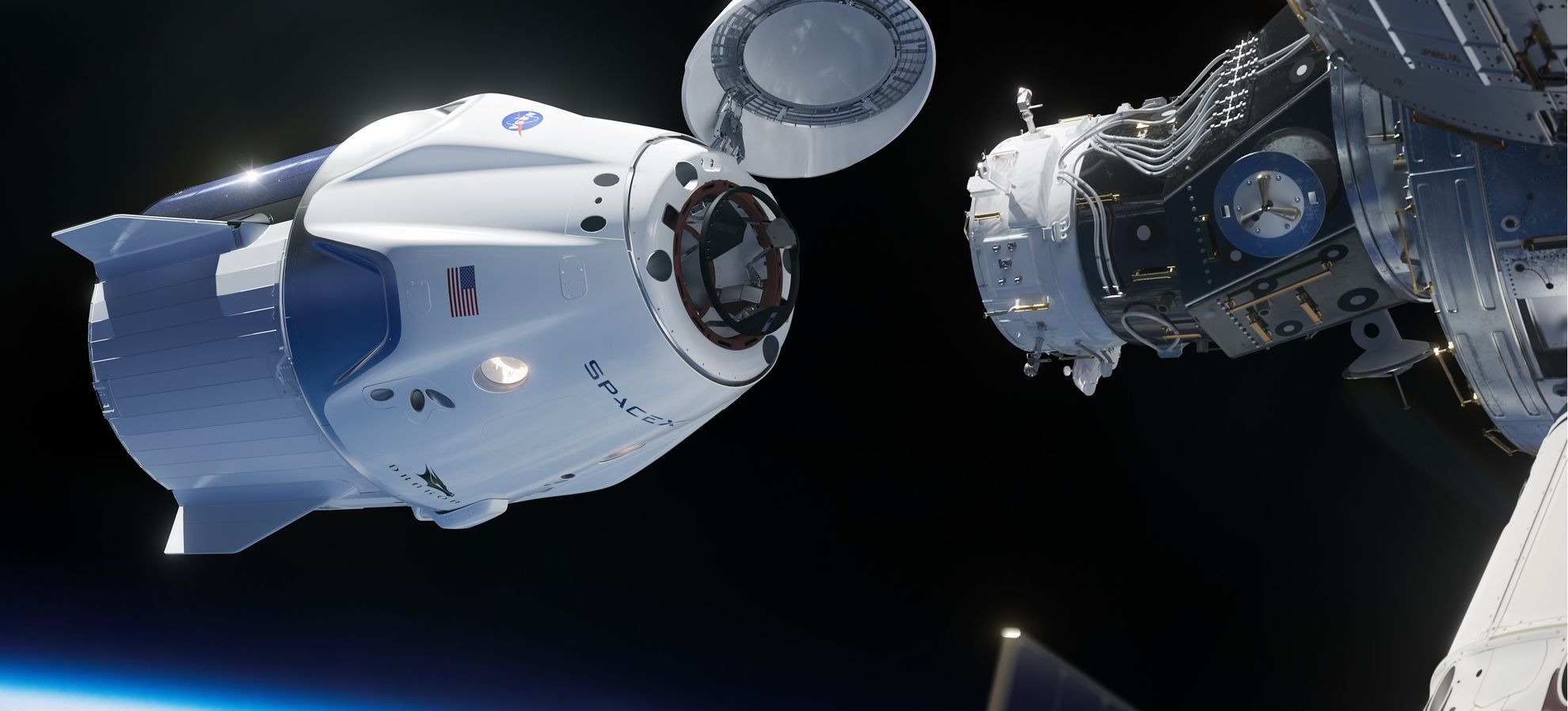
13. Space X Dragon Capsule
https://drguven.com/wp/wp-content/uploads/2020/03/spacex-manned-flight.jpg
14. Expanded Mars Colony
https://www.flickr.com/photos/breadman017/34502841226/in/datetaken/