
The Challenge
Background:
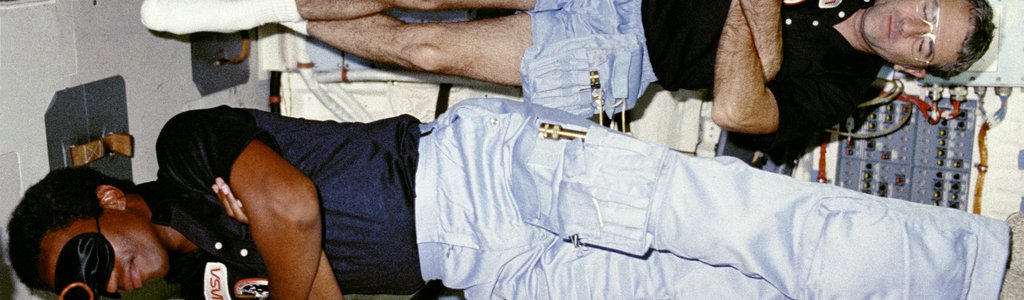
Have you ever wondered how astronauts sleep in space? Future exploration missions will have bigger crew compartments than previous Apollo missions; however, they will be smaller than current sleeping quarters on ISS. Furthermore, future spaceflight exploration crews will share a common area for sleep, which can result in disturbed sleep. Ground and spaceflight evidence shows sleep loss and circadian desynchronization may lead to reduced performance and an increased risk to safety. Similar concerns impact safety and performance of people working in many non-space industries (for example, transportation and healthcare) as well.
The overall well-being of each crewmember for future space exploration, as well as workers in other industries, will depend on guidance on sleep shifting, as well as guidelines regarding exercise and nutrition. Currently there are numerous applications that minimize jet lag effects, provide exercise guidance, and provide nutritional guidance for weight loss. However, there are no applications that support all three areas of sleep schedules, exercise regimens, and nutritional guidance. Your challenge is to develop a tool or application that encompasses these important aspects of sleep, exercise, and nutrition.
How can your tool include multiple aspects of research that have been shown to affect fatigue? Any operational tool should be capable of adapting an individual's sleep schedule with countermeasures to maintain circadian entrainment, provide exercise guidelines, and provide nutritional guidelines.
Potential Considerations:
- How can your scheduling tool indicate sleep periods (e.g., should the number of hours an individual sleeps be 5, 6, 7, or 8 hours; or should an individual’s schedule include a nap period if a situation indicates the need for additional sleep outside the main sleep period), countermeasure use (e.g., light and glasses that block light), and when to take medications if prescribed by a flight surgeon or doctor (e.g., melatonin, hypnotics, and alertness medications). Also, the application should allow for input of operations such as launch, landing, docking and undocking times, or comparable activities for applications besides spaceflight, to obtain optimal sleep periods.
- If a sleep shift schedule is for an individual traveling across multiple time zones, then the schedule should also include airports and departure/arrival times. Your tool or application may also be capable of identifying eating times and food types. In addition, the tool may include exercising regimens with exercise times and durations of workouts.
- The development of the sleep shifting schedule should have a primary focus on circadian entrainment, which will ensure scientific merit of your tool. Circadian entrainment is the primary property by the body's internal clock that is entrained by recurring signals that are synchronized to cues from the environment. If circadian entrainment is not achieved, then circadian desynchronization may occur.
- How will your tool or application benefit future spaceflight and ground operations, or individuals on Earth who experience jet lag or have sleep disruptions from shift work? How can your tool benefit other people on Earth, such as individuals supporting mission control, crewmembers training for upcoming space missions, or workers in non-space industries?
- The type of variables that are appropriate to feed into this tool are flight departures/arrival times and airports; normal total sleep hours; hypnotic, alertness, and chronobiological medications prescribed by a physician; effective countermeasures; meal times and types, and preferred exercise periods and regimens.
- NASA currently collects Respironics Actigraphy sleep data from crewmembers pre-mission, in-mission and post-mission. The sleep data is composed of total sleep time, start and end times, date of data period, sleep onset, sleep latency, sleep efficiency, wake after sleep onset, and light (white, blue, red and green) illumination. In future sleep data collection, FMS plans to also include sleep phases: light, deep, rapid eye movement, and wake. All data mentioned can be found from multiple sleep measures currently on the market.
- NASA currently uses the ISS FIT for tracking food consumption. The ISS FIT tool provides a list of ISS Space Food with fluid content, calories, sodium, protein, carbohydrates, and fat of food being consumed. There are numerous applications on the market that provide similar variables that the ISS FIT provides.
- On ISS, each crewmember exercises routinely using a cycle ergometer, treadmill and weight lifting machine. However, future exploration will not have the capacity for large pieces of exercise equipment, due to limited space within the vehicle. At this time, it has not yet been determined what exercise equipment will be provided for future space exploration. There are applications that provide workout regimens, including some with gender specific regimens and various workout categories; however, they do not provide the times of the day or duration of the exercise regimen.
For data and resources related to this challenge, refer to the Resources tab at the top of the page.
NASA does not endorse any non-U.S. Government entity and is not responsible for information contained on non-U.S. Government websites.