
Awards & Nominations
Theine has received the following awards and nominations. Way to go!
Sleep Shift Scheduling Tool
Space Theine
Summary
Our mobile first application is designed to guide any adventurous individuals in gradually advancing their circadian rhythm to synchronize it with the environment time cues of their travel destination. Carefully timed activities and reminders, which can be displayed in a list or calendar view, inform on when to eat, sleep, take medication, and perform exercise, to slowly habituate the body to the new time zone.
How We Addressed This Challenge
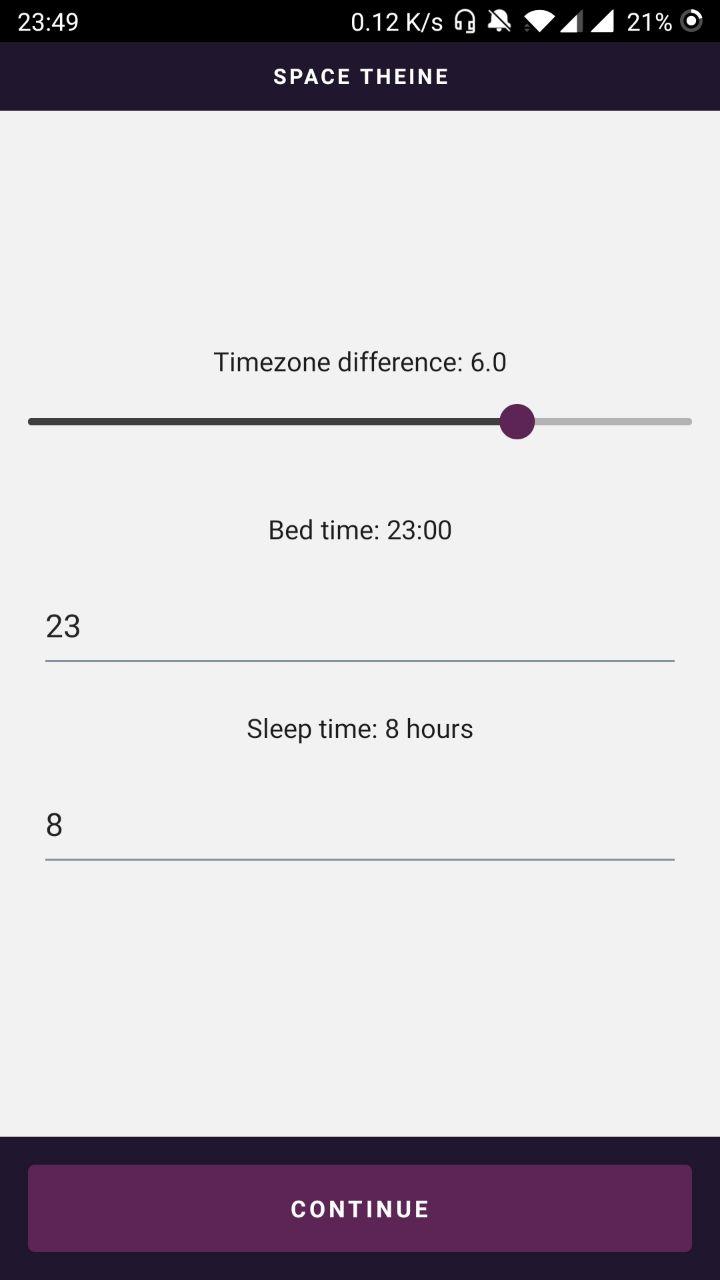
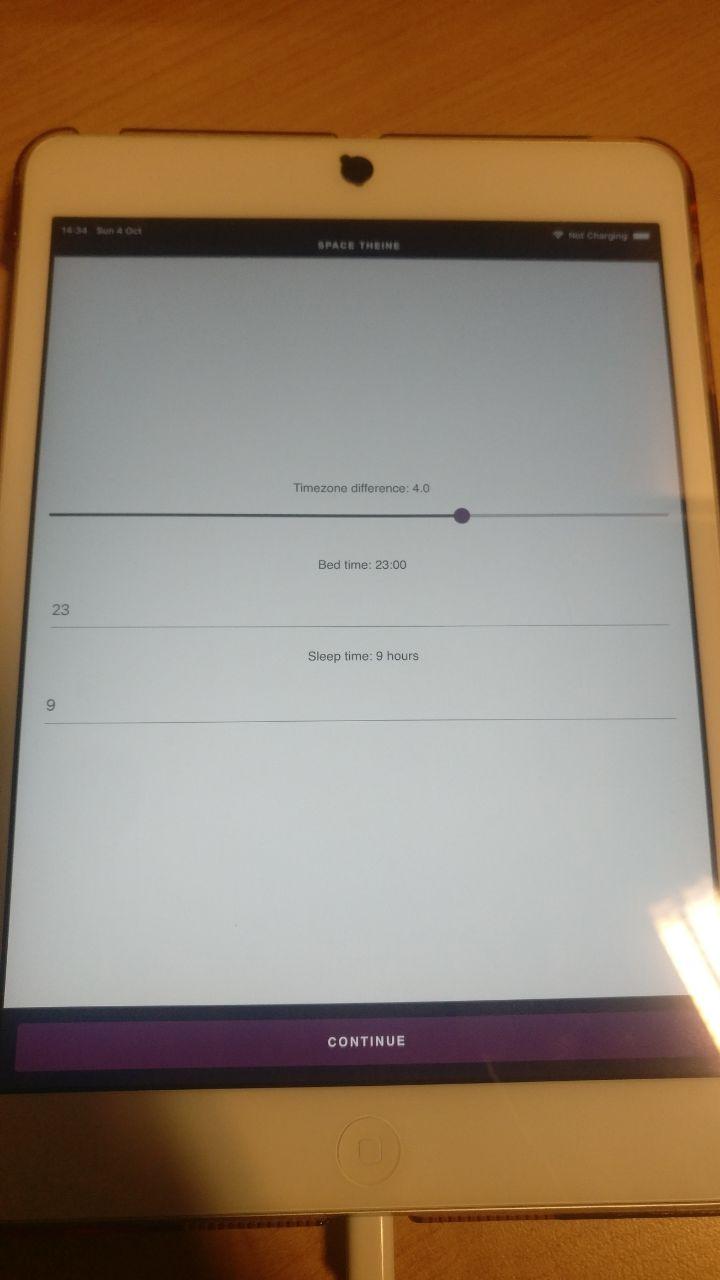
Traveling to distant locations often comes with an unpleasant side effect: jet lag. Your body falls out of its normal day-night cycle and you feel off. It affects all of us, even those traveling to the international space station, but there is a solution. We've developed an app that can help transition to a different timezone without pain. Select the timezone of your destination and provide information on your sleeping habits. Our algorithms create a schedule that slowly prepares you for the time cues of the destination environment.
Everyone carries a phone these days and since we want to frequently inform the user about upcoming activity suggestions and reminders, we decided to develop an application that is optimized for IOS and Android mobile phones. Having considered that many travellers and the crew of the ISS utilize tablets, we made sure that our app design is equally responsive on these devices. We achieved this by building on top of the React Native open-source mobile application framework, which allows us to compile the project for Android and IOS deliverables. Using this technology enabled us to save time by only having one central code base, so that all developments are reflected in upgrades to the app on any OS. At the same time, using the framework allowed a focus solely on improving the features and user experience without having to worry about the underlying logic required to deploy and run the software. The fact that we were able to create a fully functional app with a wide range of features, in less than 20 hours of programming and only two developers, shows the advantage we gained from our choice of technology.
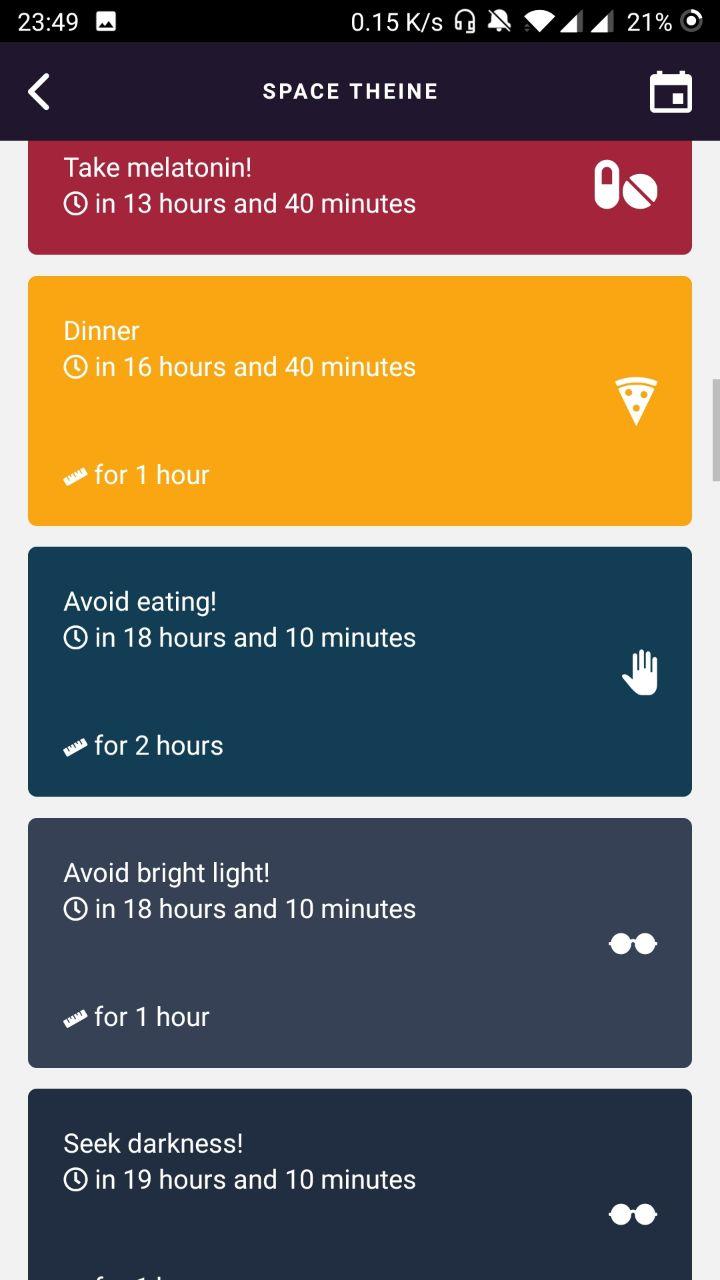
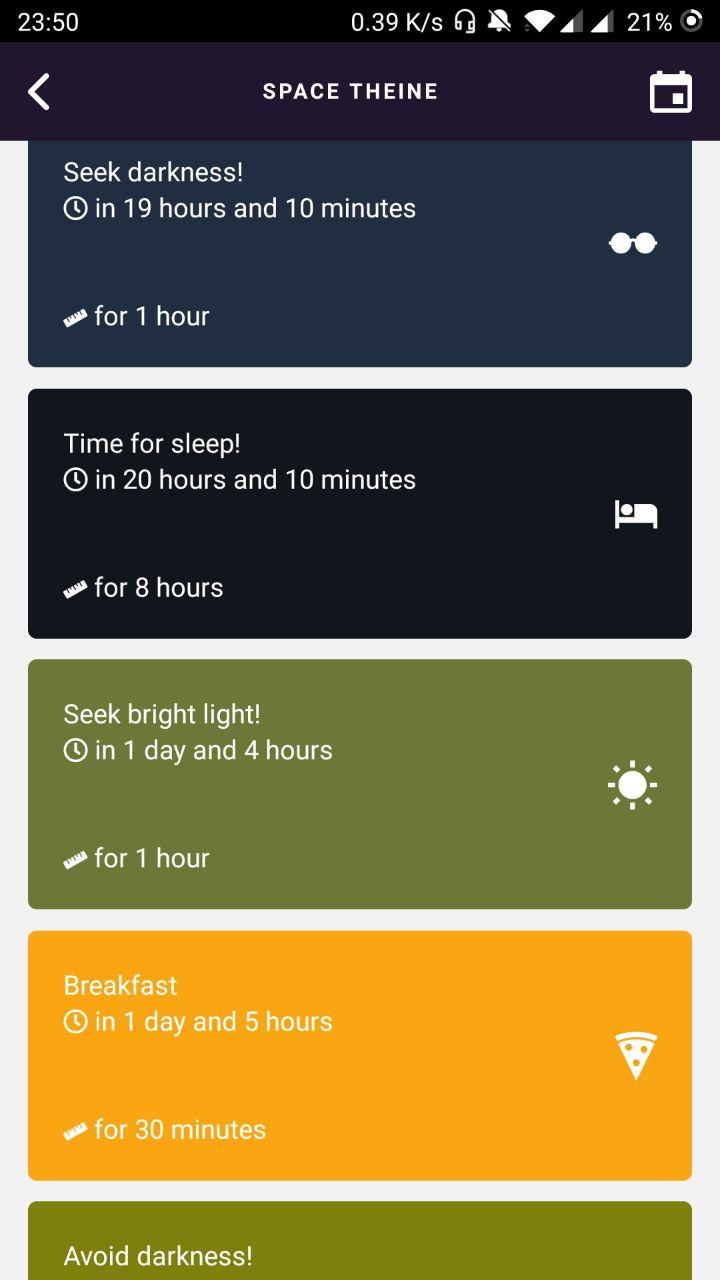
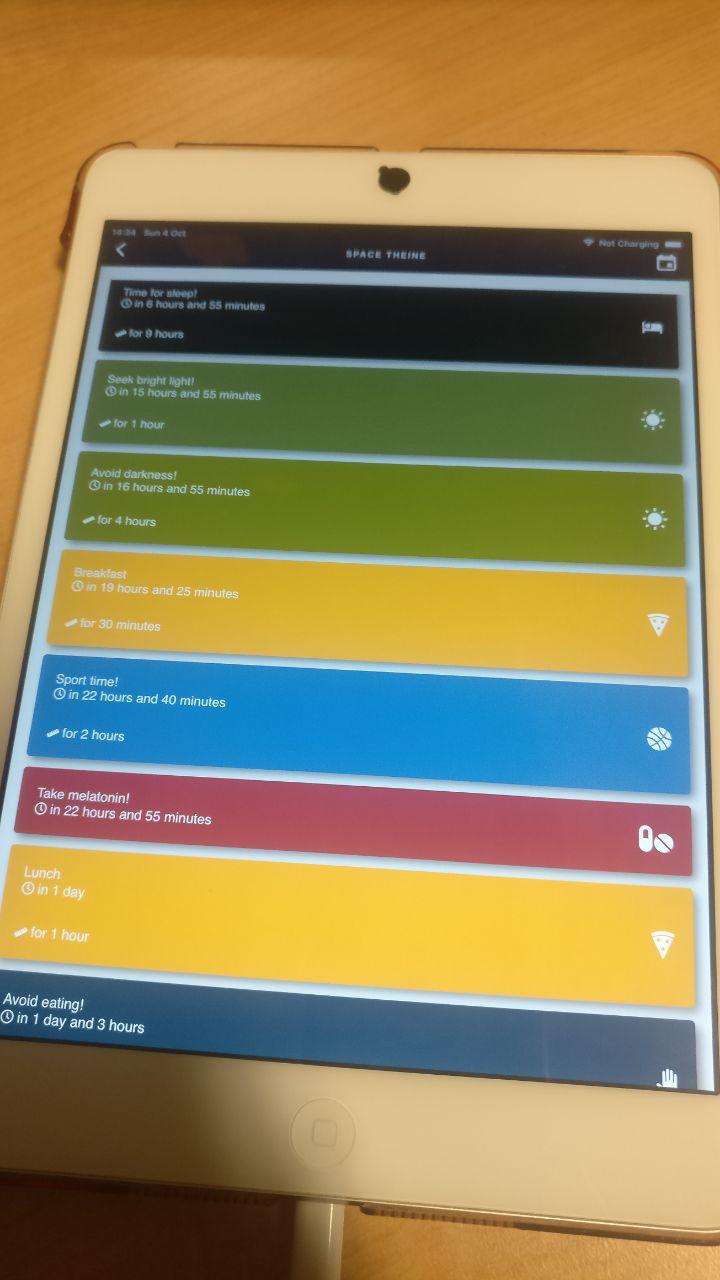
To assist the user effectively, we decided that our app should generate activities and reminders that guide behaviour for a gradual transition of the circadian rhythm to the environment of the destination time zone. A list of color coded cards with icons representing categories present these suggestions. Activities are actions the user should commit to over a specific period. Driven by our research, the app calculates and schedules sleeping, eating and exercise activities. For further assistance, we display the total duration of the activity alongside the time that has passed since it was suggested. Reminders are short actions or preparations that the user should undertake. Based on our findings, our app emits reminders for taking melatonin and seeking or avoiding different light intensities. Just like the activities, the reminder cards display the time that has passed since the suggestion.
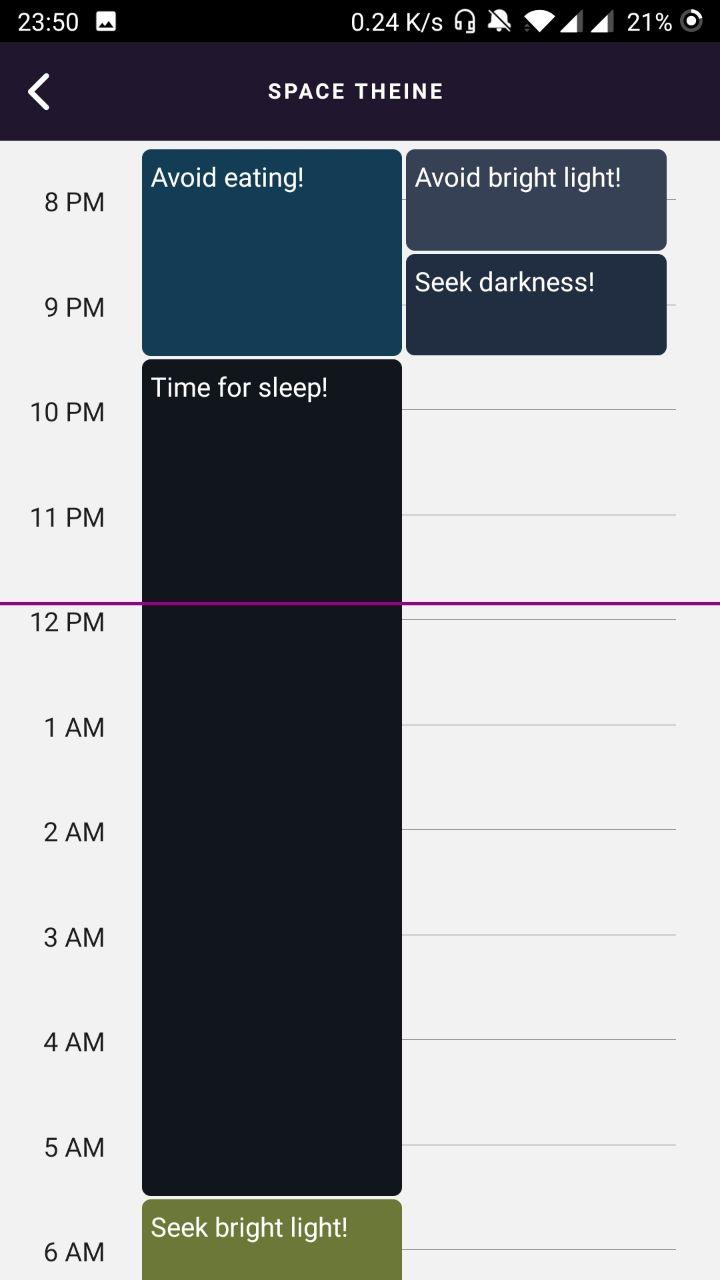
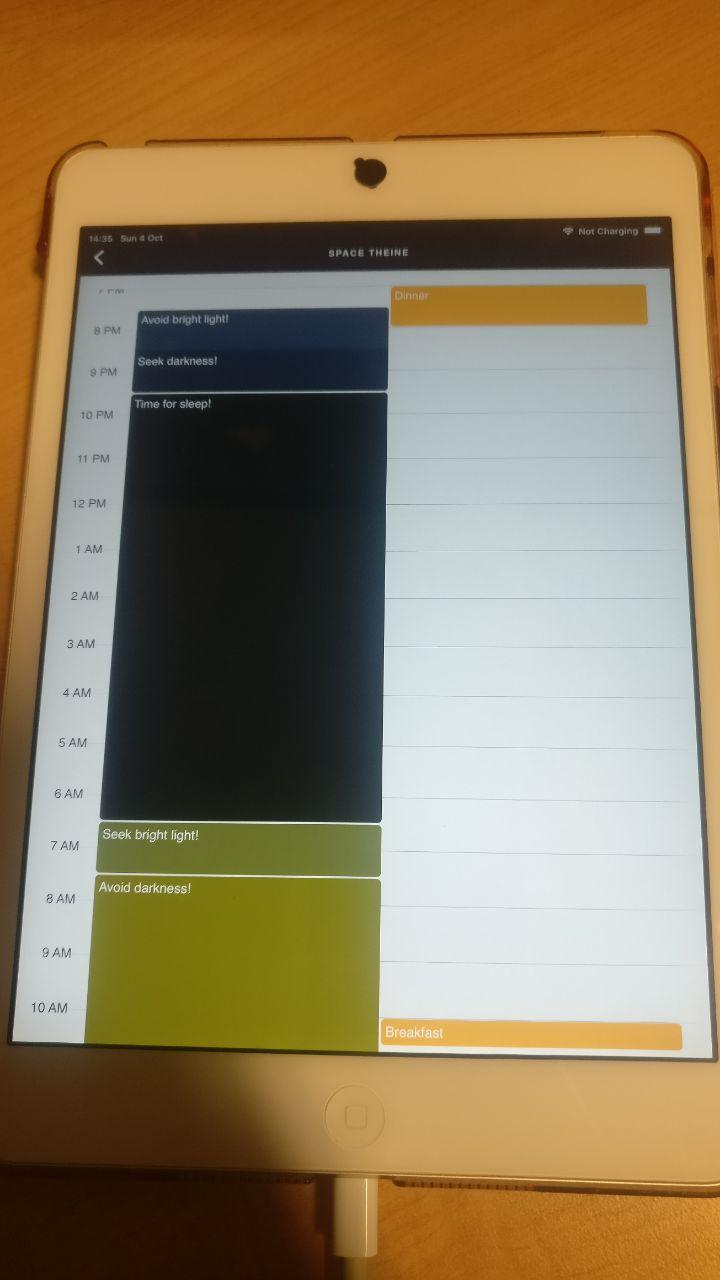
In addition to the live updating list of scheduled recommendations, our app provides a calendar view. This makes it easier to see which activities and reminders occur at the same time. It also facilitates an understanding of how the timing of each suggestion type is shifted gradually towards aligning with the destination time zone. A purple line indicates the current location time, so that the user can see and prepare for the upcoming tasks.
How We Developed This Project
We are a group of three: Przemysław Kukulski, Marcin Lesniowski, and Max Kossatz. Przemysław and Marcin were colleagues in Poland, about a year ago, and Max is from Germany and went to university in the UK with Przemysław. We have not worked together for a while, but know, that we all love a good challenge and have a shared interest in the advancements of humankind, including space travel, which is why we came together to work on this project. Marcin and Przemysław are software developers with a specialization in web-development and Max is a solutions architect with project management skills, which is a great constellation of complementing knowledge and skills, resulting in a highly enjoyable and productive weekend.
Throughout the preparation, research, and product development phase, we tried to follow agile development practices. We set up a Trello board for managing issues that we moved across “Extension Ideas”, “MVP Todo”, “In Progress”, and “Done” columns. In most calls and throughout the research and development phase, we used a Miro board to brainstorm and sketch out ideas. To increase the speed and motivation, we very regularly came together in Google Meet calls, where we discussed progress and the issues that had to be tackled next. We deliberately chose to let one or two of us develop features with very little planning in advance, while someone else engaged in extensive research, so that we could recursively reflect on changes or extensions that had to be made. Although this meant regularly fixing application logic, it excelled our overall speed of progress. Our approach became very dynamic and mostly direct communication based, which resulted in us almost not using our issues board at all because we constantly shared and discussed activities. This led to some inconveniences close to the end because some development ideas were forgotten, but this was not a substantial problem since we ran out of time anyways. In Google Drive, docs were collaboratively filled with research findings and feature concepts. This was very useful because it led to a highly condensed information pool that we actively used when programming the activity and reminder scheduling logic.
Early on, our research concluded that the overall mobility of the user, as well as the increasing use of mobile devices on the ISS, meant that we should develop a mobile first app. Since two of our team members had some experience in React, a JavaScript library for building user interfaces, we decided to try and use React Native, an open-source mobile application framework, to develop the product. This meant having to do additional research on how to use this technology, but with a bit of luck and experience the two developers in the team were able to quickly build a foundation for our app. We chose TypeScript over JavaScript because the additional type hints and structure capabilities allowed us to write code that is easier to understand by fellow team members and it reduced the likelihood of introducing bugs. One of our team members had virtually no TypeScript experience at all, which was thought to not be a problem at first, but the increasing need for a third developer after most of the research was completed, resulted in the team having to do a quick training session.
The research was conducted by splitting up the areas of concern and forming questions that we would try to answer as best as we could. This was done by browsing through NASA and NASA partner sites, as well as scientific research paper hubs. We answered the questions with references to our sources, so that other team members could look at those, to gain an equal understanding and to check if their understanding matches the derived conclusions. The answers to the questions were then used when programming the application logic, as each answer could more or less be mapped to a function in the backend code. These functions drive the activity and reminder suggestion scheduling processes.
How We Used Space Agency Data in This Project
We formulated the following research questions, which led our investigation:
By how much can/should a sleeping period be shifted by per night?
How does melatonin affect sleep? How much and when should melatonin be consumed (quantity & time)?
How does the change of a time-zone affect the environment surrounding the individual and how does this in return affect the sleeping requirements?
How does exercise help to transition into different sleeping patterns? How does the duration and intensity of exercise have an affect? Are there specific not machine-based exercise types that are particularly useful, considering also gender?
How does the intake of food and liquid help transition into a different sleeping pattern? How does the time of intake have an impact?
Using Google Dorking we first searched for all resources we could find on the websites of NASA, ESA, JAXA, CSA, and CNES. Most of the information we found on these sites was great for an introduction into the topic. A few sites gave us very precise information with which we answered some research questions, but we were left with a lot of missing knowledge. It seemed like we did not have access or at least couldn't find data-sets that could have helped us more and a direct inquiry to NASA sadly resulted in a rejection because of data protection regulations. We used the resources mainly to understand and extract concepts that we then used to do a more in depth investigation. This led us to many research papers and articles that we compared for validity. We discussed our findings as a group to make sure that any conflicts in understanding or conclusion were resolved.
Project Demo
Video:
https://drive.google.com/file/d/1owGj11lIgafp-_Zkh9KCZicDRZmFwCnt/view?usp=sharing
Screens:
https://raw.githubusercontent.com/mrcne/space-theine/main/screens/android1.jpg
https://raw.githubusercontent.com/mrcne/space-theine/main/screens/android2.jpg
https://raw.githubusercontent.com/mrcne/space-theine/main/screens/android3.jpg
https://raw.githubusercontent.com/mrcne/space-theine/main/screens/android4.jpg
https://raw.githubusercontent.com/mrcne/space-theine/main/screens/ios1.jpg
https://raw.githubusercontent.com/mrcne/space-theine/main/screens/ios2.jpg
https://raw.githubusercontent.com/mrcne/space-theine/main/screens/ios3.jpg
Project Code
Data & Resources
https://www.ncbi.nlm.nih.gov/pmc/articles/PMC2829880/
https://www.ncbi.nlm.nih.gov/pmc/articles/PMC1249488/
https://www.frontiersin.org/articles/10.3389/fphys.2019.00927/full
https://link.springer.com/article/10.1007/s00213-012-2869-8
https://www.nasa.gov/vision/space/livinginspace/spacefood_feature.html
https://www.ncbi.nlm.nih.gov/pmc/articles/PMC3655529/
https://pubmed.ncbi.nlm.nih.gov/18497298/
https://journals.sagepub.com/doi/10.1177/1559827614544437
https://www.pnas.org/content/112/48/E6691
https://www.nasa.gov/audience/foreducators/stem-on-station/learning_launchers_got_rhythm
https://iss.jaxa.jp/med/healthy_sleep_en.pdf
https://global.jaxa.jp/press/2018/02/20180220_shiseido.html
https://www.nasa.gov/mission_pages/station/research/astronauts_improve_sleep
https://www.nasa.gov/mission_pages/station/research/circadian
https://www.researchgate.net/publication/7799615_Circadian_rhythms_sleep_and_performance_in_space